Selling connectivity through partners? Stop being their help desk

Mikk Lemberg
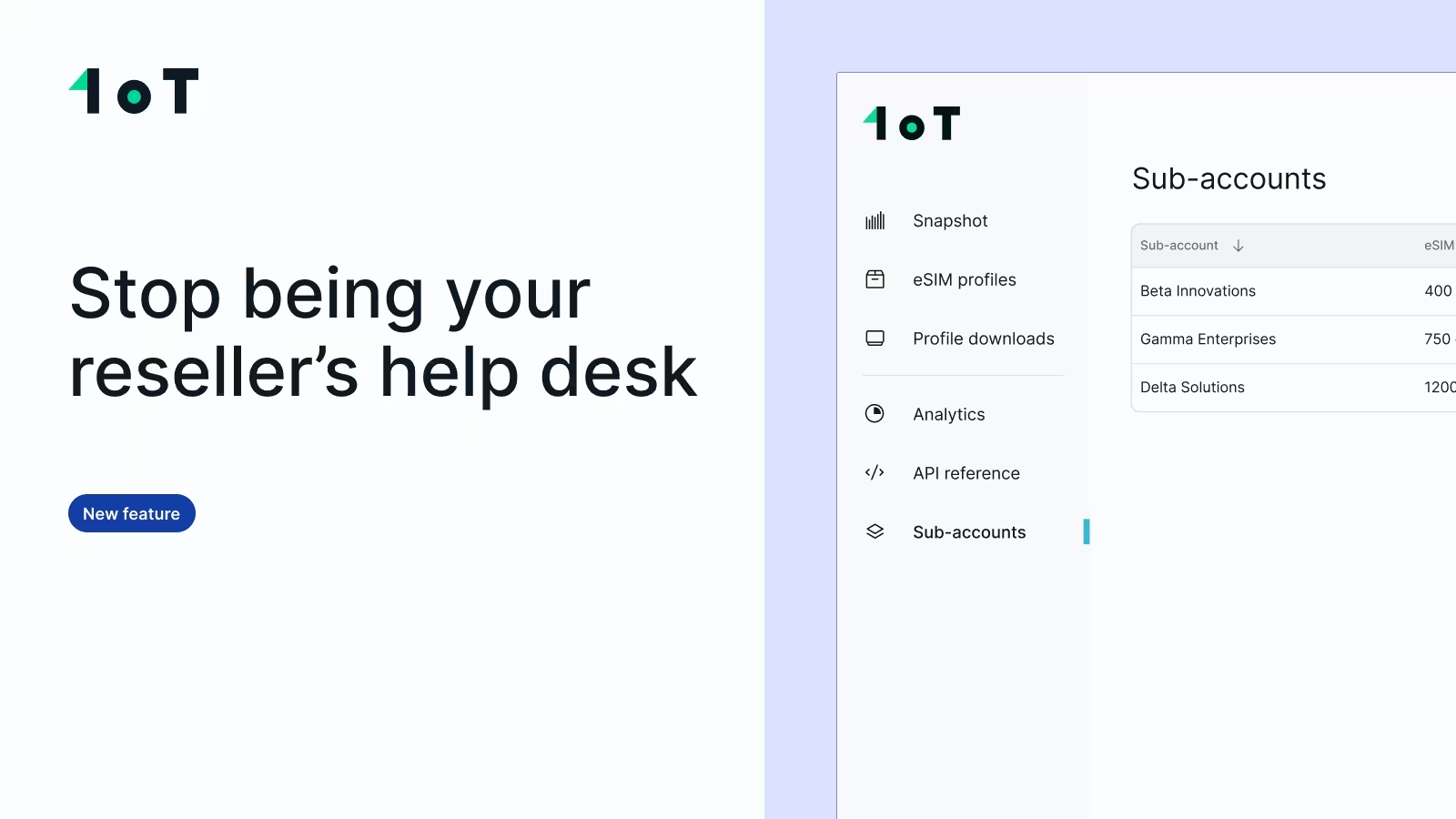
Sub-accounts in the 1oT eSIM Core give your resellers a self-service workspace, and get your week back
Every partner who sells your connectivity needs something from you, and they need it from you specifically. A batch of activation codes. A few more profiles assigned. A status check on a transaction that's stuck. Someone new who needs a login. None of it is hard. All of it lands on your team. So the channel you stood up to grow faster has quietly made you the bottleneck: every new reseller is another set of requests, another thread, another person waiting on your side to go click the thing.
That's the real cost of reselling connectivity, and it's not the technology. It's the middleman's work. Worse, it scales backwards: the more partners you win, the more of your week vanishes into provisioning on their behalf.
Sub-accounts take that off your plate. Your resellers get their own self-service workspace on top of your SM-DP+ — they pull their own codes, run their own operations, manage their own people. You keep ownership of the estate and a full record of what they do.
The growth is in the channel — and in people's pockets
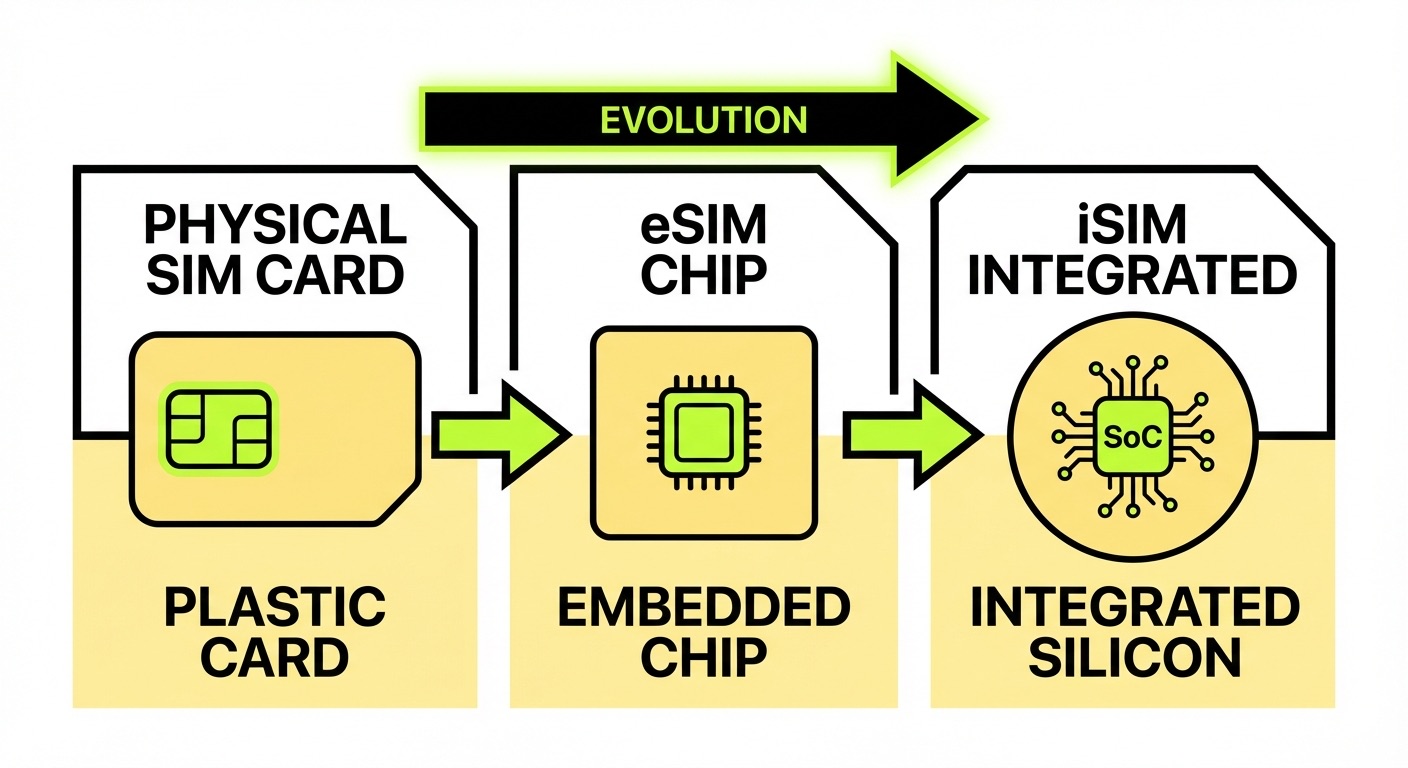
GSMA Intelligence expects eSIM smartphone connections to reach around 4.9 billion by 2030, roughly 55% of all smartphone connections. And travel eSIM, the fastest-moving slice, is on track to grow some 380% between 2025 and 2030 as travellers swap roaming for a code they download before takeoff.
Every one of those connections is a profile someone has to provision, and behind a growing share of them is a reseller who'd rather pull the activation code themselves than wait on you. What's been standing between you and that growth was never demand. It was operational drag: manual provisioning, manual code distribution, manual access management, with every handoff waiting on a person on your side. The answer the industry keeps arriving at is self-service over manual intervention. Sub-accounts apply that to the one relationship that had been skipped: you and your resellers.
What it looks like without the middleman
Say a reseller, Beta Innovations, signs on Monday morning.
They log in to a workspace that's obviously theirs. They see their assigned eSIM profiles and nothing else: not your inventory, not another partner's assets, just their own pool. They generate the activation codes they need and hand them to their customers. They link their own eUICCs. They import codes and profiles they've bought from other vendors, so their whole connectivity book sits in one place. They add their own teammates. They point their own API at the CMP they already run.
They never email you. They never wait on you.
And you haven't lost sight of any of it. Their assets, their members, their activity — all visible to you whenever you want to look. Every operation is yours to oversee, and everything they do lands in the event log. You've stopped approving requests one at a time. You're watching a channel run itself, with the receipts to prove it.
How it works
Sub-accounts is a multi-tenancy layer inside the eSIM Core UI — the same SM-DP+ console you already use. No second portal to stand up, no parallel system to keep in sync. You carve your estate into sub-accounts and give each reseller a scoped slice.
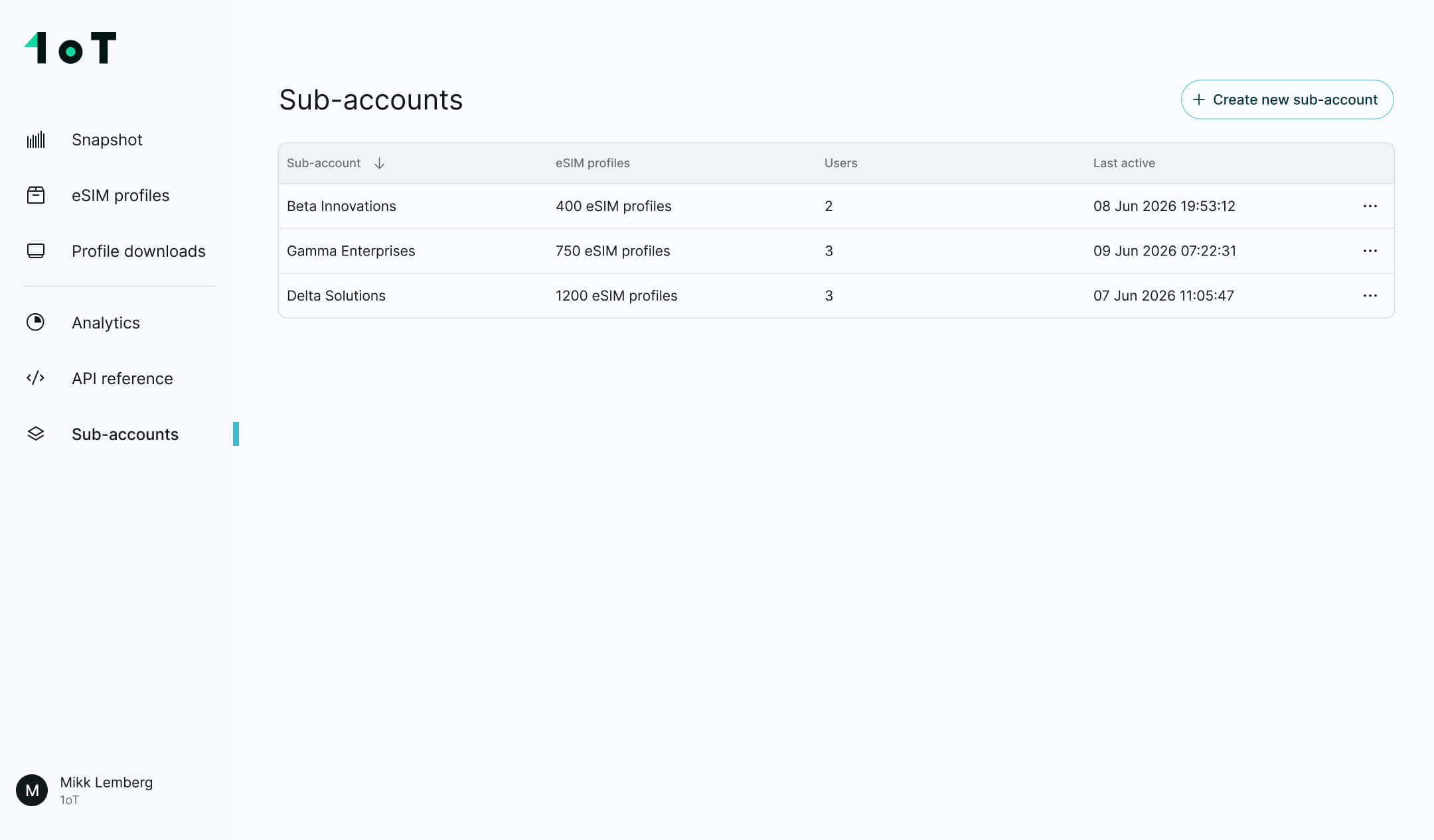
Setup is three steps that read like a sentence: name the company, assign the assets, add the users. As you assign profiles and cards, the system labels them with the company name automatically, so your estate stays readable however many partners you add.
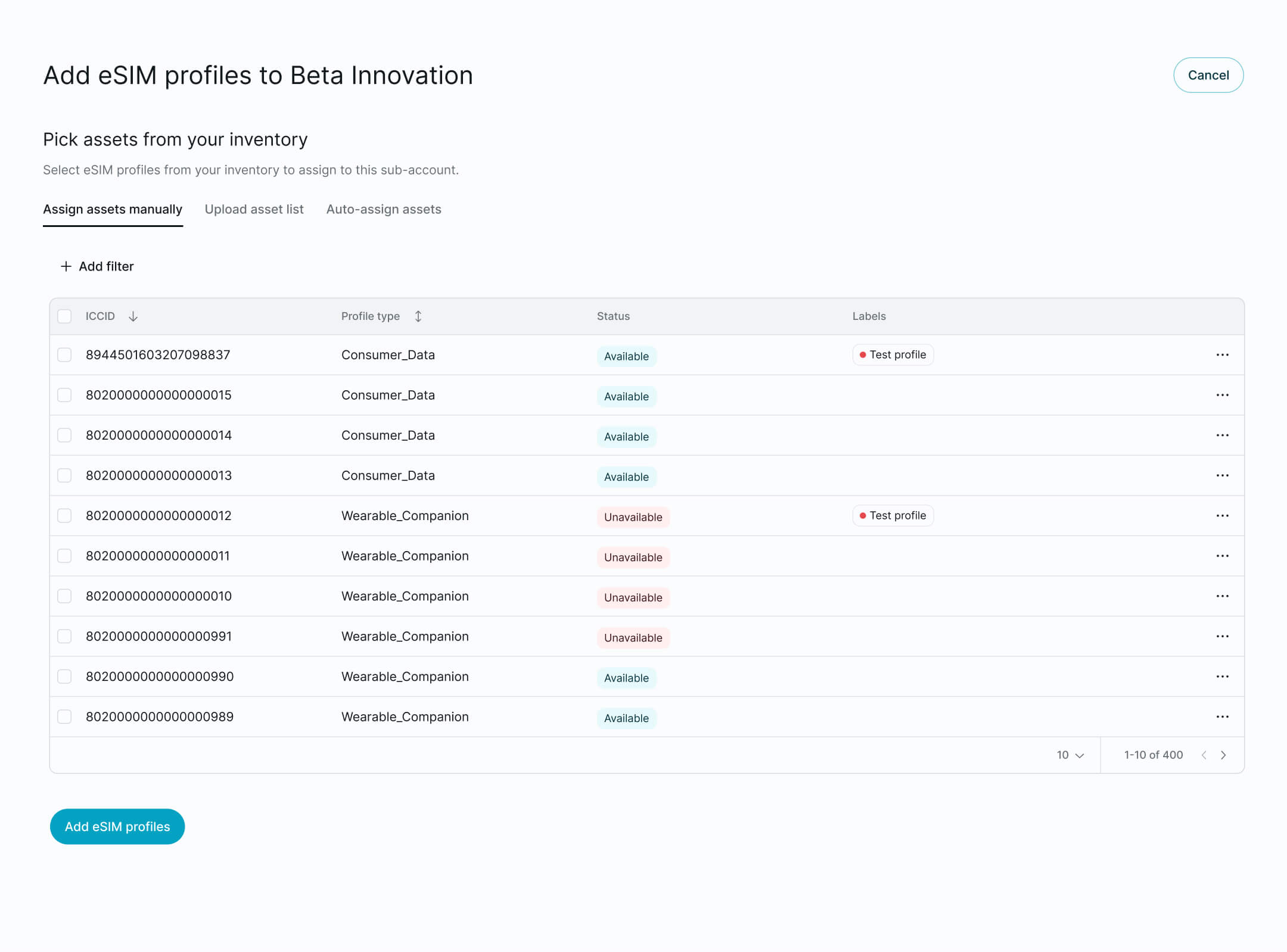
That's the whole setup. The reseller lives with their own pool, and the work moves to their side of the line.
What the reseller gets, and what stays yours
One idea holds it together: real autonomy for the partner, full oversight for you. Same assets, seen from two sides.
What the reseller can do on their own:
- See only their assigned assets — their pool, never yours or anyone else's
- Generate, share, and re-generate activation codes for their customers
- Track profile downloads and troubleshoot download errors as they happen
- Invite team members, governed by the existing role permissions (Administrator, Operator, Viewer)
- Connect their own API to customer-facing services — websites and apps that pull activation codes on demand — or their billing system
What stays with you, the Main account:
- See every sub-account's assigned profiles and invited members
- Assign more profiles from Inventory whenever a partner runs low
- Step in and operate on a sub-account's assets yourself when you need to
- A complete event log: every action, yours included, recorded and auditable
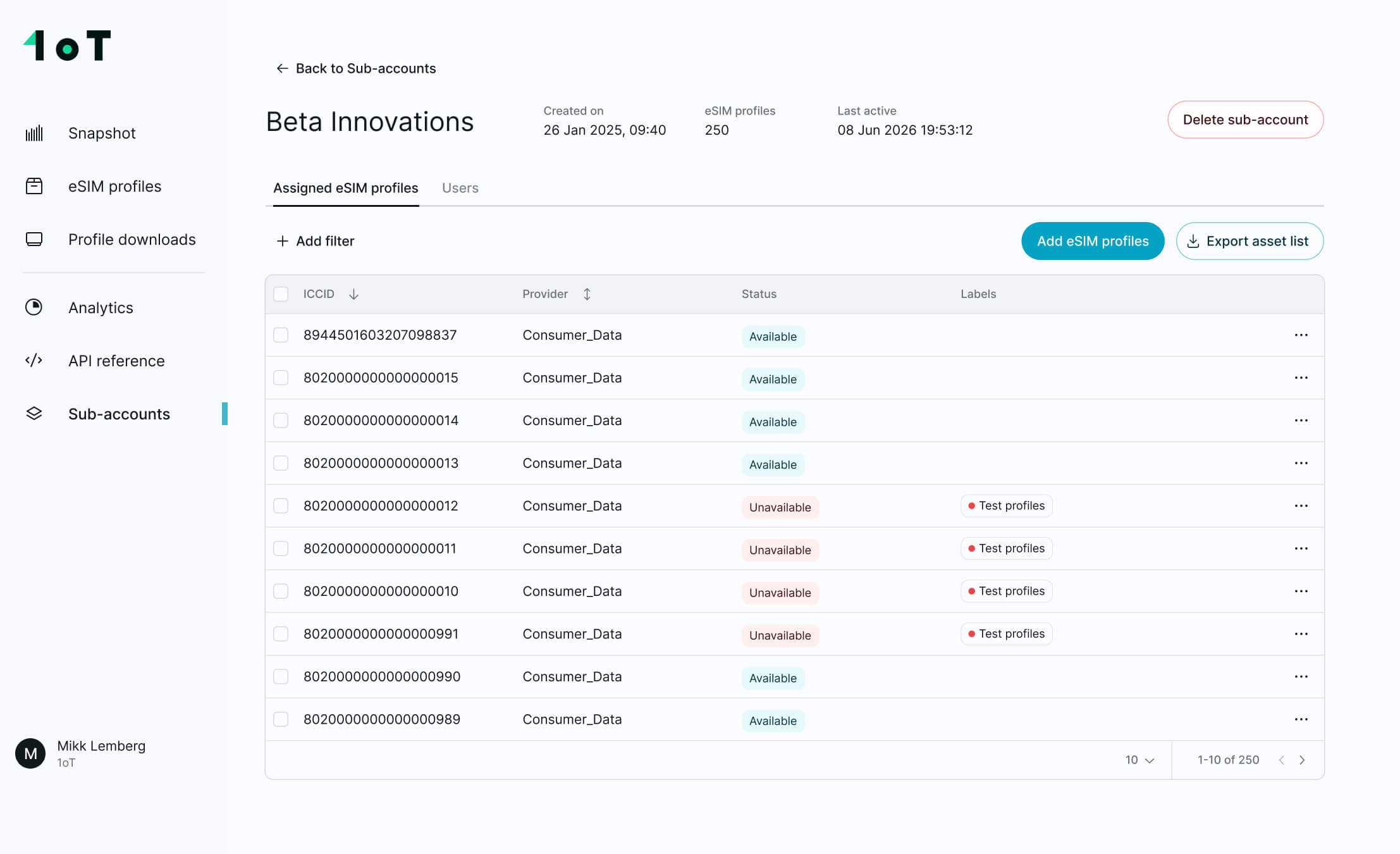
Here's where most tools tap out. They'll hand you a single pane of glass over your own fleet and call it a day. The harder thing — the thing worth paying for — is letting a partner operate independently while you keep the profiles and a record of every move. That's not a read-only window onto your system. It's a real working surface for them, fenced and logged for you.
What you get out of it
You add a reseller without hiring someone to babysit them. You onboard a partner in an afternoon instead of a week of back-and-forth. And you can license the whole thing white-label, which turns your SM-DP+ from a cost center into a revenue line.
It carries forward, too. The same model extends to eIM as you move toward SGP.32, so the channel you build now isn't something you rebuild next year.
Book a demo of Sub-accounts in the 1oT eSIM Core UI, and see what the channel feels like when you're out of the middle of it 👇












.avif)
.avif)