Choosing the Right Connectivity Architecture: eSIM vs. Physical SIM vs. iSIM

Mikk Lemberg
For technical IoT product managers and hardware engineers, the SIM is no longer just a piece of plastic. It has evolved into a strategic component of the device architecture, affecting everything from the Bill of Materials (BOM) and power budget to global logistics and long-term lifecycle management. Choosing between a traditional physical SIM, an eUICC-capable eSIM, or an integrated SIM (iSIM) requires balancing technical constraints with commercial scalability. This guide breaks down these technologies to help you decide which architecture supports your deployment's specific needs.
Defining the SIM Landscape for IoT
Before comparing performance, it is essential to distinguish between form factors – the physical shape – and capabilities, which involve the software and standards.
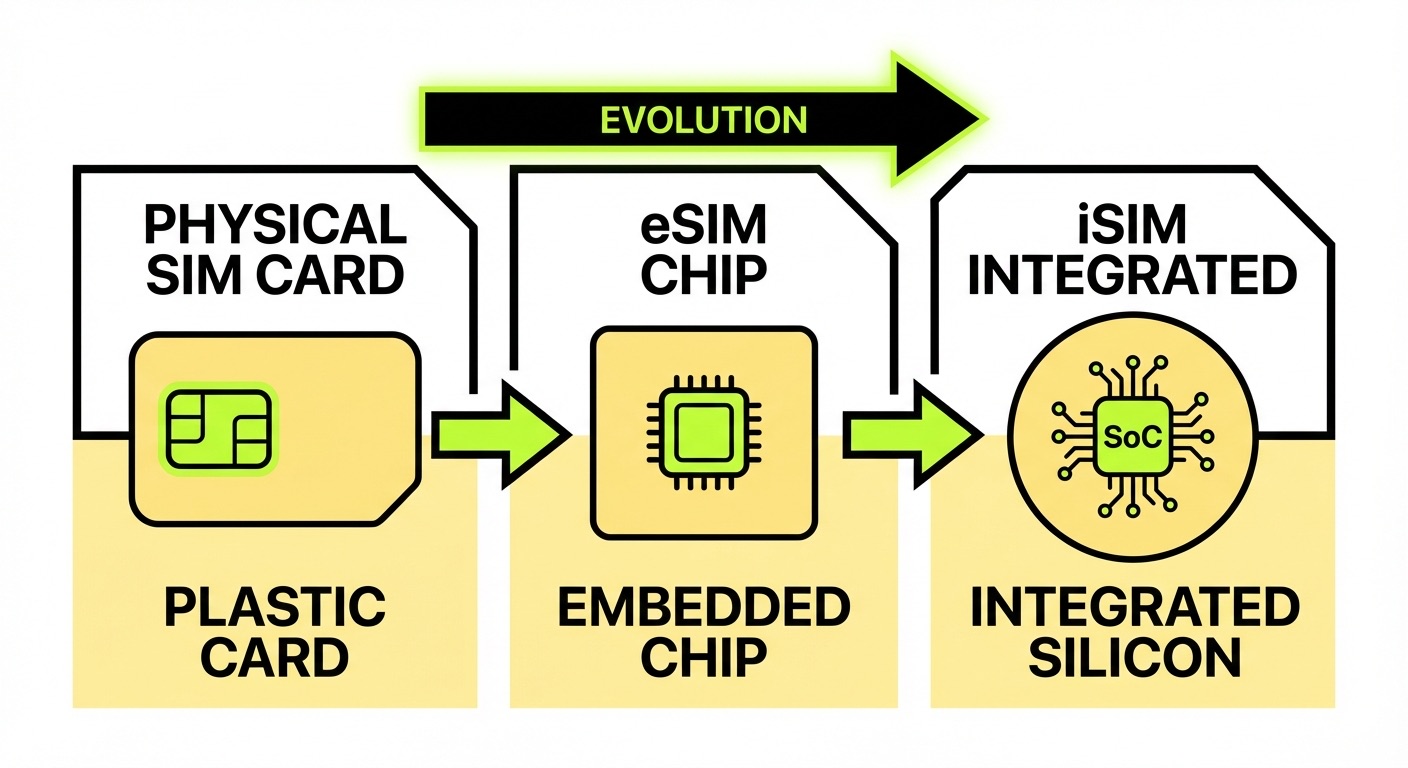
Physical IoT SIMs (UICC)
These are the standard removable cards available in Mini (2FF), Micro (3FF), Nano (4FF), and MFF2 form factors. While they are often associated with consumer devices, industrial-grade physical SIMs are designed to withstand extreme temperatures ranging from -40°C to 105°C, as well as significant vibration and moisture levels.
eSIM (eUICC)
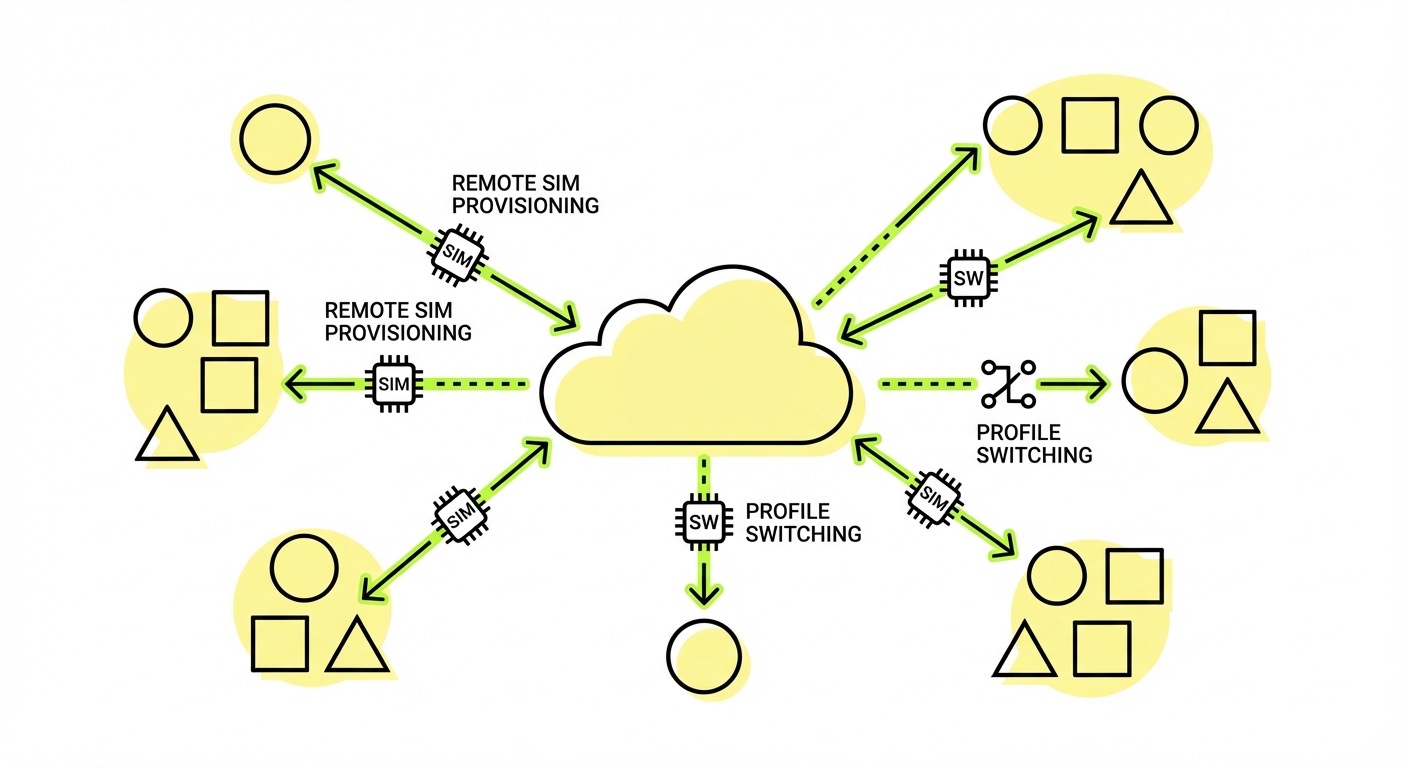
eSIMs come in all form factors, but technically, the term refers to eUICC (embedded Universal Integrated Circuit Card) capability. This capability allows for Remote SIM Provisioning (RSP), meaning you can swap carrier profiles over-the-air (OTA) without physical access to the device. This standardized technology can exist on a removable plastic card, a soldered MFF2 chip, or even within an integrated chip.
Integrated SIM (iSIM)
The Integrated SIM (iSIM) represents the next step in hardware evolution by moving SIM functionality into the device's System-on-Chip (SoC). By eliminating the need for a separate hardware processor and sharing the modem's processor and memory, the iSIM significantly reduces the device's footprint and power consumption.
Soft SIM
Unlike hardware-based solutions, a Soft SIM has no hardware-backed secure element. It is a purely software-based implementation of SIM functionality. While this makes it inexpensive to deploy, it lacks the hardware-level security standardized by the GSMA and is generally not recommended for mission-critical IoT applications due to its vulnerability to cloning and tampering.
Technical Comparison: Hardware, Scalability, and Management
For ultra-constrained designs, such as wearables or medical sensors, the physical footprint is often the primary driver of architecture. A Nano-SIM (4FF) measures 12.3 x 8.8mm, while an MFF2 chip is significantly smaller at 6 x 5mm. Transitioning to an iSIM eliminates this footprint entirely, freeing up PCB real estate for larger batteries or additional sensors. However, the choice of hardware also dictates how you manage the device fleet over several years.
The core problem with physical SIMs in IoT is the "truck roll." If a carrier goes bankrupt, raises prices, or shuts down a legacy network like 2G or 3G, a physical SIM requires manual replacement. This is a logistical nightmare for devices deployed in the field, such as bird trackers or e-scooters. In contrast, eSIMs enable remote profile management via GSMA-certified servers. The SGP.32 standard for IoT further optimizes this for the IoT ecosystem by removing the reliance on SMS for profile triggers. This is a critical advancement for NB-IoT and LTE-M devices that may not support SMS consistently.
- Physical SIMs offer high security via a hardware secure element but remain limited in remote provisioning and highly susceptible to vendor lock-in.
- eUICC-capable eSIMs provide full GSMA RSP support across all form factors, maintaining high security while allowing for global scalability.
- iSIMs provide the highest power efficiency and the smallest footprint, though the ecosystem for carrier support is still maturing compared to eSIM.
- Soft SIMs offer high power efficiency and low costs but are generally avoided for professional IoT due to low security levels.
Security and Compliance Standards
Security in IoT is anchored in the "Root of Trust." Physical SIMs, eSIMs, and iSIMs all utilize a hardware Secure Element to store credentials and encryption keys. eSIM technology is governed by the GSMA SAS-SM (Security Accreditation Scheme), which certifies the production environment and the remote provisioning platforms. This ensures that the entire lifecycle of the profile – from generation to download – is handled within a secure, audited framework.
Soldered form factors like MFF2 and iSIM offer superior physical security. It is nearly impossible to desolder a chip to misuse a data plan in another device, which is a common risk with removable SIMs in outdoor deployments like micromobility. In contrast, removable SIMs are susceptible to theft, requiring additional management features like IMEI locking to mitigate risks. Soft SIMs, lacking a hardware-isolated environment, remain vulnerable to reverse engineering and unauthorized profile cloning.
Lifecycle Costs: Beyond the Unit Price
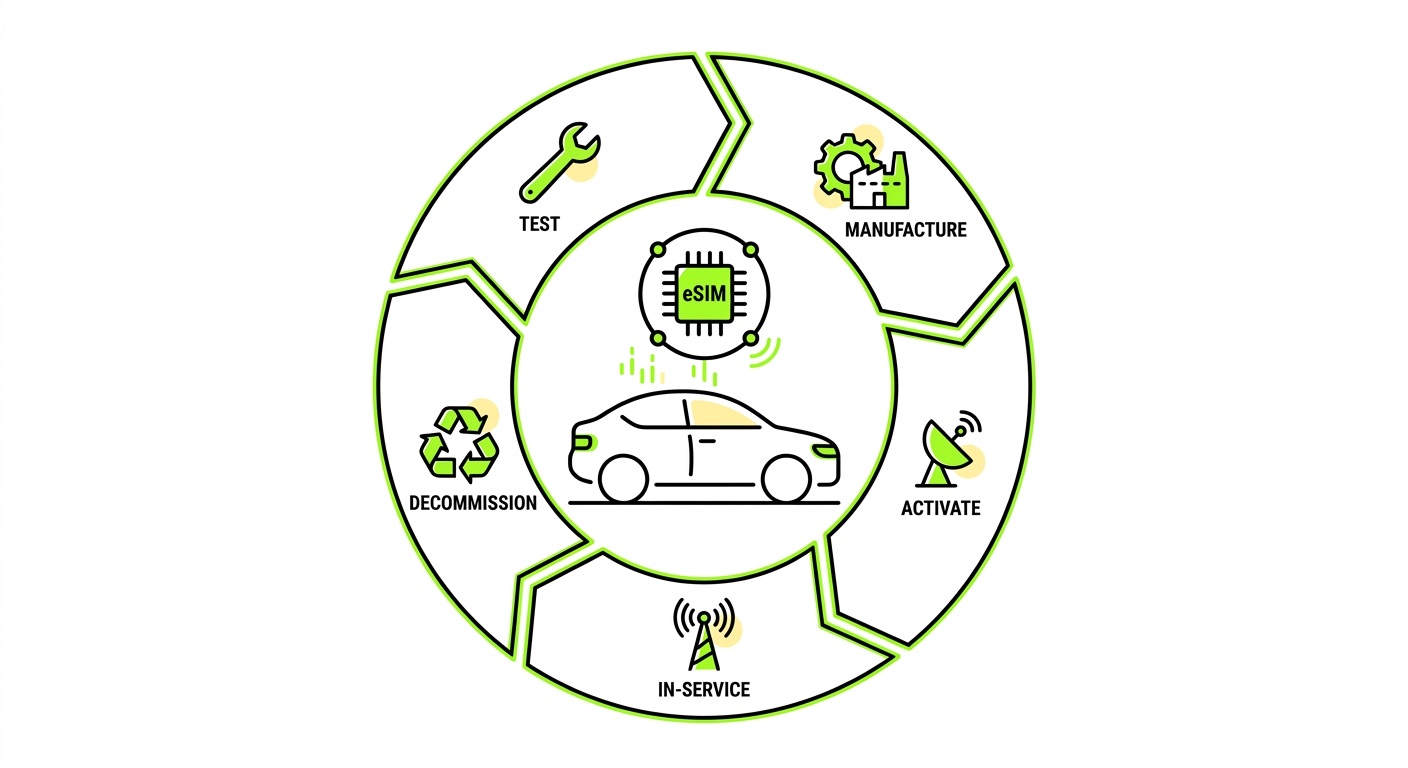
While a physical SIM may have the lowest initial unit cost, the Total Cost of Ownership (TCO) often favors eSIM and iSIM for long-term deployments. This is due to several operational efficiencies:
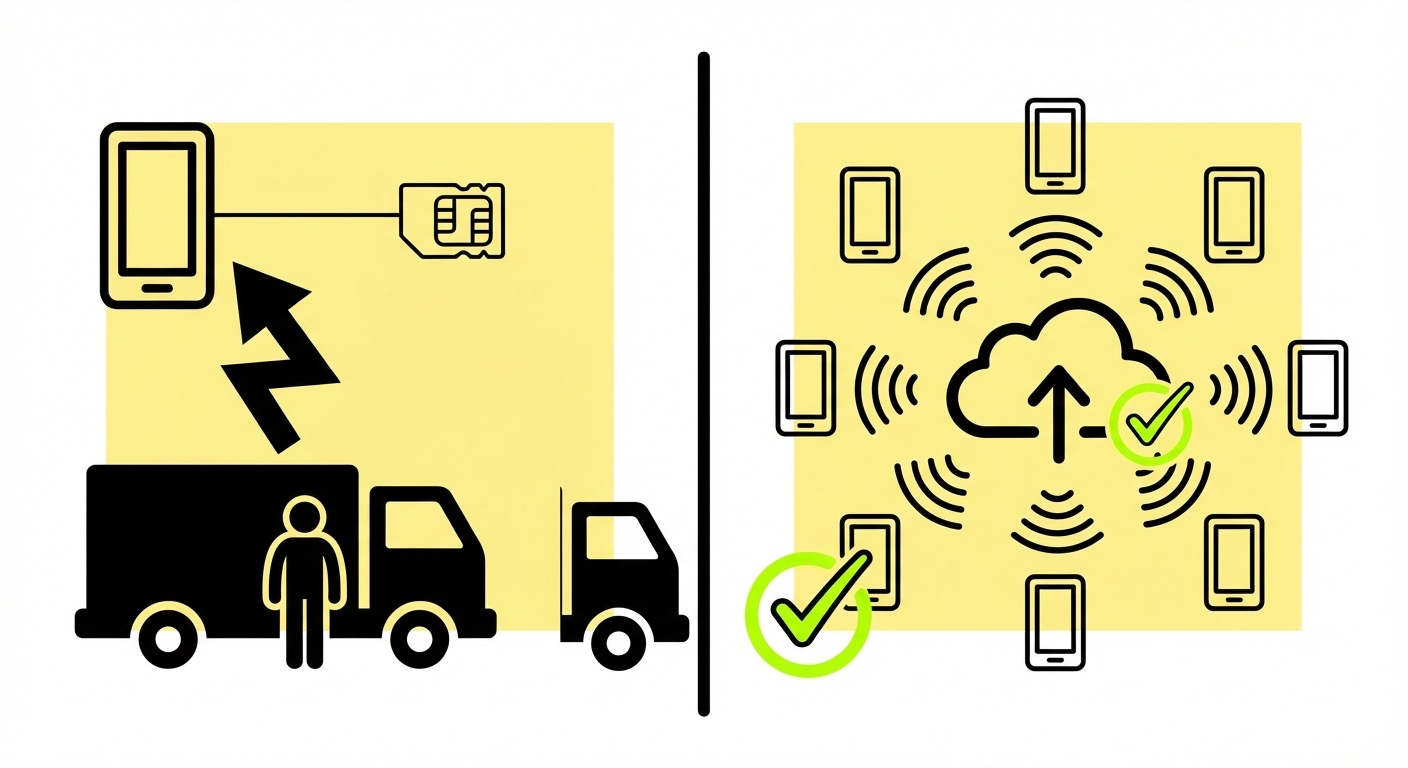
- Manufacturing and Logistics: Using an eSIM allows for a single SKU (Stock Keeping Unit). You do not need different SIMs for different regions; you can solder one chip and provision localized carrier profiles during factory testing or upon arrival in the destination country.
- Maintenance: Remote provisioning eliminates the need for expensive field technician visits. A simple OTA command can update thousands of devices, shielding your business from the costs of manual intervention.
- Carrier Independence: One of the most significant benefits is the prevention of vendor lock-in. If your current provider's quality of service drops or roaming rates increase, you can switch to a different carrier profile without recalling the hardware or replacing the physical components.
When to Choose Each Option
Selecting the right architecture depends on the scale, location, and power constraints of your specific project.
When to Choose Physical IoT SIMs
This option is best if the deployment is small-scale, typically under 1,000 devices, and localized to a single region. If the hardware is easily accessible for manual maintenance and you are using legacy modules that do not support eUICC commands, the simplicity of a physical SIM may outweigh the benefits of more advanced tech.
When to Choose eSIM (MFF2 or Removable)
eSIM is the recommended standard if you are scaling globally across multiple regions like the USA, EU, Brazil, or China. It is also the ideal choice for devices with a 10+ year lifecycle that need protection against network sunsets. If security and tamper resistance are high priorities, a soldered MFF2 eSIM provides the best balance of reliability and flexibility.
When to Choose iSIM
Consider iSIM if power consumption is your most critical constraint, particularly for battery-powered NB-IoT sensors that need to last a decade. It is also the go-to solution when the device footprint must be as small as possible. This path requires working with a System-on-Chip partner that supports integrated eUICC and ensuring your connectivity provider can handle the integrated provisioning flow.
Navigating the Connectivity Maze with 1oT
Choosing the right SIM technology is only half the battle; the other half is managing the connectivity lifecycle effectively. 1oT provides a carrier-independent connectivity platform that supports physical SIMs, eSIMs, and emerging iSIM standards. This independence allows you to focus on your product while the platform handles the complexity of carrier negotiations and regional compliance.
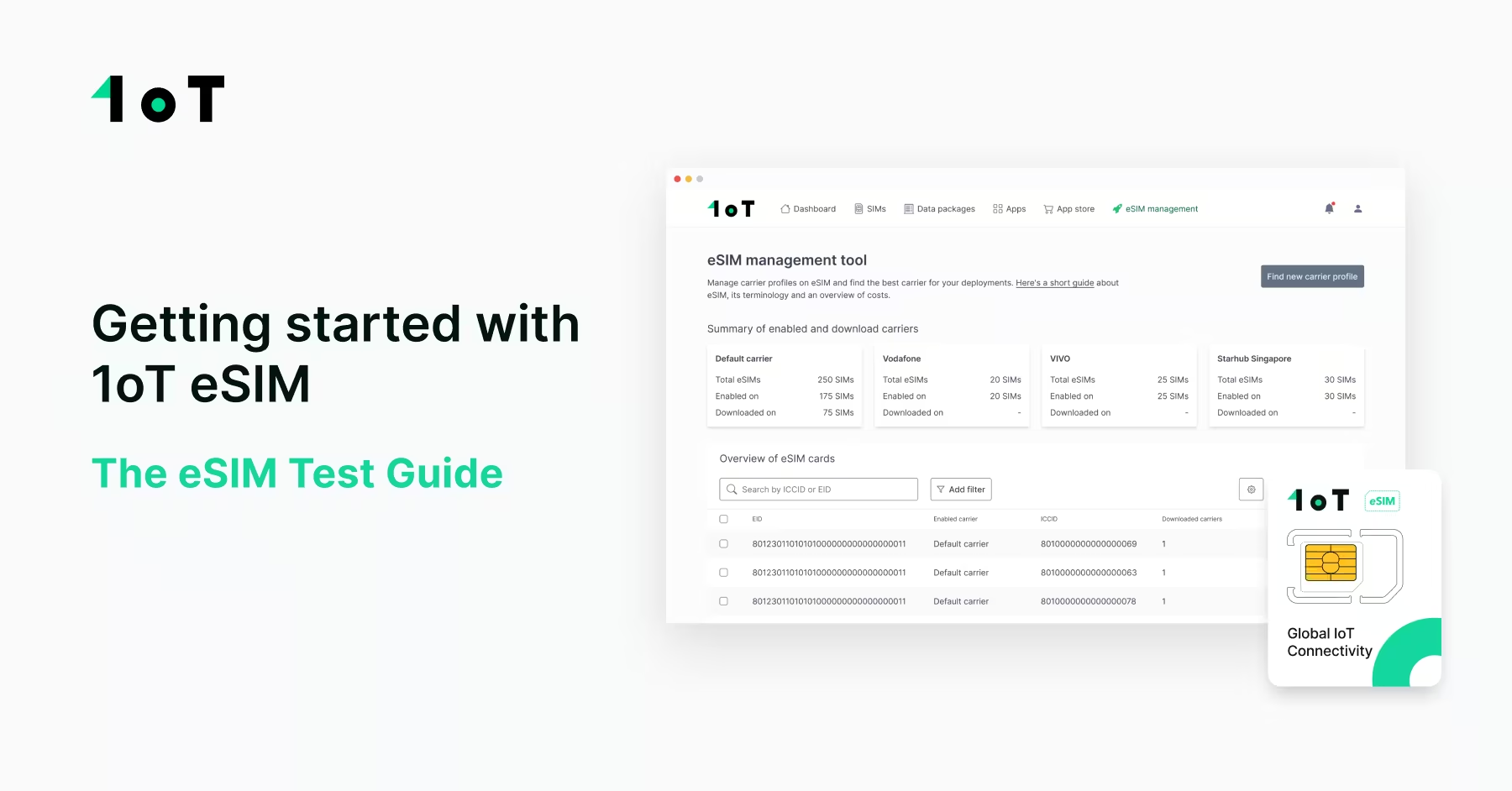
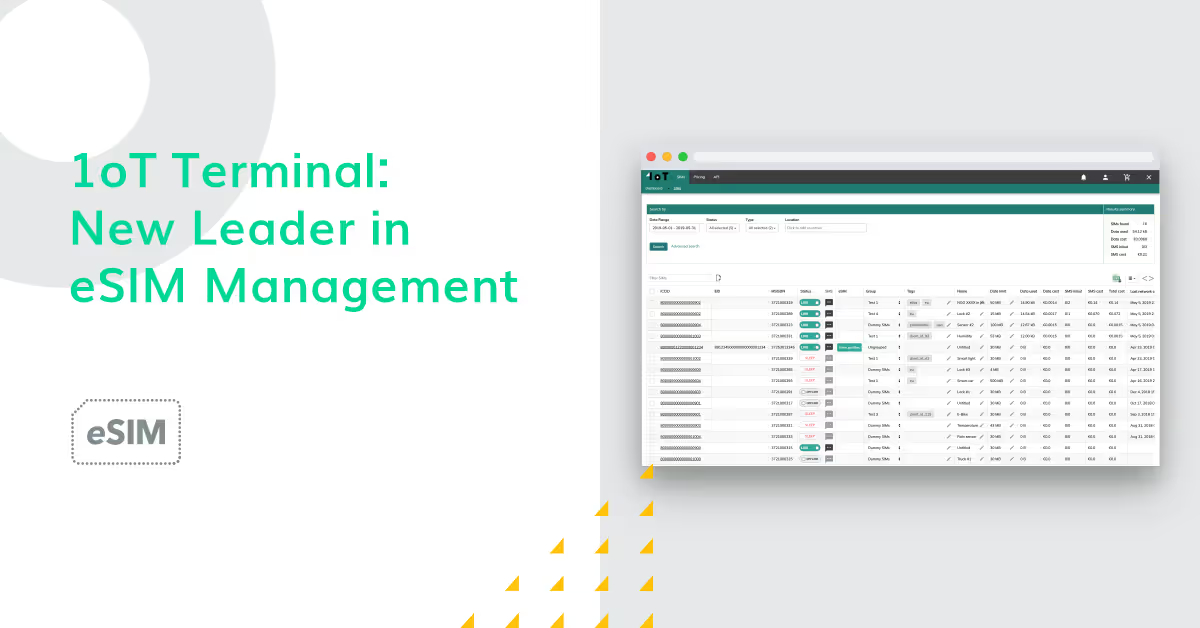
With 1oT’s eSIM infrastructure, you gain access to over 1,000 networks across 190+ countries through a single interface. Whether you need to use an eSIM management tool to compare profiles for a specific region or automate your SIM security settings via IMEI locking, the 1oT Terminal acts as a unified management layer. By decoupling the hardware from the service provider, 1oT ensures that your choice of SIM today doesn't limit your business opportunities tomorrow.






.avif)