


Turkey permanent roaming restrictions – complete IoT guide
Don’t let Turkey permanent roaming restrictions catch your IoT business off guard. Learn the rules, key requirements, and how to keep your devices connected.
Everything you need to know about permanent roaming restrictions and regulations around the world, and what they mean for your IoT deployments.

Sales Director
Getting your IoT devices connected in another country is one thing. Keeping them connected for years? That's where it gets complicated.
Just because a device can connect to a network abroad doesn't mean it's allowed to stay there indefinitely. Some countries have strict permanent roaming restrictions, while others leave it up to agreements between telecoms.
Understanding these requirements beforehand is critical to choosing the right connectivity setup and avoiding unexpected costs or, worse, a complete loss of connectivity.
So, where do permanent roaming restrictions apply, and what do they mean for your IoT deployments?
Permanent roaming happens when an IoT device operates long-term in one country while using a SIM or eSIM profile from an operator based in another country. Instead of connecting to its home network, the SIM relies on roaming agreements to access local networks.
Unlike temporary roaming during a trip abroad, permanent roaming allows devices to stay connected in the same country for months or even years.
Think of a smart meter manufactured in Europe and deployed in Turkey. It might connect to a Turkish network using a European SIM through an international roaming agreement. But if that meter is expected to operate there for the next ten years, the connectivity arrangement needs to allow for that.
And that's not always the case.
Permanent roaming restrictions aren't the same everywhere. Some countries impose strict regulatory limits, while others leave it up to agreements between telecoms.
And it's not always governments calling the shots.
Local telecoms can impose their own restrictions, too, sometimes simply to protect their business from foreign competition.
So, how do you keep your devices connected without getting caught out?
Here's what you need to get right:
Governments restrict permanent roaming for several reasons:
But not every country takes the same approach.
As the GSMA's permanent roaming IoT guidelines highlight, some countries explicitly prohibit permanent roaming, while others impose licensing, registration, or additional requirements that effectively restrict it.
Before deploying: Find out which rules apply to your devices and whether you need local approvals, registrations, or a different connectivity setup.
A connectivity provider might advertise global coverage. But that coverage comes with a catch: it doesn't guarantee your devices can roam indefinitely.
Even where regulations don't restrict permanent roaming, local telecoms may impose their own limits through commercial agreements.
Before deploying: Confirm that your agreement actually allows long-term IoT roaming, which networks and technologies it covers, and whether duration limits or extra charges apply.
If permanent roaming isn't permitted, local connectivity may be the answer.
But that doesn't necessarily mean replacing thousands of SIM cards or juggling a different telecom in every country.
Depending on your hardware and eSIM setup, you may be able to switch to an approved local telecom profile remotely.
Before deploying: Check whether local connectivity is required and whether your devices can switch profiles remotely.
Regulations change. Commercial agreements change. And the telecom that works best today might not be the right fit five years from now.
The last thing you want is thousands of devices stuck with a connectivity setup that no longer works.
That's where eSIM technologies, including SGP.32-based solutions, can make a difference. With compatible devices and infrastructure, you can manage and switch connectivity profiles remotely.
Just remember: eSIM doesn't make permanent roaming restrictions disappear. It gives you more flexibility to adapt when your connectivity arrangements need to change.
Before deploying: Make sure your devices can switch profiles remotely and that you have a fallback plan if your current connectivity arrangement stops working.
Luckily, you don’t have to figure it all out on your own. At 1oT, we help IoT businesses navigate permanent roaming restrictions, secure the right connectivity for each market, and manage global deployments without the added complexity.
Planning to deploy IoT devices internationally? Here's an overview of markets where permanent roaming rules and related connectivity requirements deserve particular attention.
The EU's Roam Like at Home (RLAH) rules have made roaming much easier for travellers. But for IoT devices that spend years abroad, it's a different story.
Since June 2017, these rules have allowed travellers to roam across the EU without extra charges, subject to fair-use limits. In January 2026, Ukraine and Moldova joined the Roam Like at Home area.
But Roam Like at Home doesn't automatically guarantee unrestricted permanent roaming for IoT devices.
A smart meter sitting in another country for ten years is a very different use case from someone travelling abroad with their phone.
The European Commission's 2025 roaming market review confirms that permanent M2M and IoT roaming remains subject to wholesale commercial negotiations.
For IoT companies, this means checking the actual connectivity agreement rather than assuming EU roaming rules cover everything.
Before deploying, confirm which countries and networks allow your devices to roam permanently, whether additional charges or restrictions apply, and which technologies are included. A device using LTE-M, for example, needs an agreement that covers that technology too.
Turkey restricts permanent roaming, which means IoT companies need to plan ahead if their devices will remain in the country for years.
For qualifying data-only devices using foreign SIMs, the relevant threshold is more than 90 accumulated days within a 120-day period.
Devices identified as permanently roaming can have their IMEI blocked from Turkish networks. And because the restriction applies to the device's identity, simply swapping the physical SIM won't fix an existing IMEI block.
For these deployments, businesses need local Turkish connectivity and must meet the applicable device import and IMEI registration requirements.
These steps should be sorted out before deployment, not when devices are already in the field and struggling to connect.
Fortunately, we’re here to help.
Through our partnership with Turkcell, 1oT provides native Turkish connectivity and handles the applicable IMEI registration process, helping you meet local requirements.
You can manage your devices in Turkey alongside your international deployments through one platform, one contract, one invoice, and one support team.
Brazil is another market where IoT companies need to pay close attention to their connectivity arrangements.
The Brazilian telecom regulator, Anatel, has specific rules governing permanent roaming. Its national roaming framework includes a 90-day restriction on devices remaining outside their home provider's service area.
However, this national roaming restriction should not be confused with a blanket 90-day rule for foreign SIMs roaming internationally in Brazil.
International IoT deployments need to be assessed against the applicable regulations and telecom agreements.
And roaming isn't the only consideration.
Depending on the devices and business model, companies may also need to meet local authorization, registration, and equipment certification requirements.
Anatel has been reviewing aspects of M2M and IoT connectivity, including how permanent roaming restrictions affect the market. But ongoing regulatory discussions don't automatically change the rules currently in force.
For companies looking to deploy devices in Brazil, the safest approach is to confirm the permitted connectivity arrangement and any local requirements before getting devices into the field.
Looking for a way around these connectivity challenges? Learn how 1oT's localized eSIM profile helps overcome roaming restrictions in Brazil.
Permanent roaming isn't outright prohibited across the board in the UAE, but IoT deployments are subject to specific regulatory requirements.
The Telecommunications and Digital Government Regulatory Authority (TDRA) oversees the telecom sector, including the rules governing IoT services.
For companies deploying IoT devices in the UAE, there are a few things to consider:
One important distinction: these are broader IoT regulatory requirements, not necessarily permanent roaming restrictions.
Registering an IoT service also doesn't replace any separate telecom licence required to provide regulated connectivity services.
For long-term deployments, confirm that both your connectivity arrangement and your business model meet local requirements.
Want to know more? Read our guides on getting started with IoT connectivity in the UAE and successful IoT deployments in the Gulf region.
Oman is another market where companies should confirm the rules before relying on international roaming for IoT deployments.
The relevant requirements depend on the connectivity arrangement and any conditions imposed by the Telecommunications Regulatory Authority (TRA).
Before deploying, check whether your roaming agreement allows your devices to remain connected, if additional approvals are required, or if local connectivity would be a better option.
Saudi Arabia has specific requirements for IoT connectivity, overseen by the Communications, Space and Technology Commission (CST).
Under its IoT Regulations, updated in July 2024, SIM cards used for IoT services must meet requirements involving telecom service providers licensed in Saudi Arabia.
The key is making sure your connectivity arrangement meets local requirements, not just that your SIM can connect to a Saudi network.
China brings its own set of challenges for IoT businesses.
It's not just about whether a foreign SIM can connect to a local network. Companies also need to consider SIM registration, eSIM provisioning, and data regulations.
Here's what matters:
Not every data transfer requires the same approval process. China introduced new exemptions and adjusted thresholds in March 2024, so businesses need to check which requirements apply to their specific situation.
There are also penalties for non-compliance. Under Article 46 of the Data Security Law, unlawfully exporting important data can lead to fines ranging from RMB 100,000 to RMB 1 million, with more serious violations potentially reaching RMB 10 million.
For IoT companies, all these requirements add another layer of complexity.
Getting devices connected is only part of the challenge. Keeping them compliant with local registration, provisioning, and data regulations is just as important.
In North America, permanent roaming restrictions often come down to individual telecom policies and commercial agreements rather than blanket national bans.
Some telecoms support long-term IoT roaming, while others impose duration limits, additional charges, or restrictions on specific use cases.
If your devices will spend years in the United States or Canada, make sure your connectivity provider's agreement explicitly supports that use.
A localized telecom profile can also be an option, depending on the deployment and available networks.
The goal is to avoid discovering unexpected restrictions after thousands of devices are already in the field.
Explore 1oT's multi-network IoT connectivity options for North America.
India has specific requirements for M2M and IoT connectivity, including rules around SIM registration, telecom services, and eSIM management.
Companies obtaining local M2M SIMs must comply with applicable Know Your Customer (KYC) requirements.
For devices entering India with foreign eSIM profiles, local profile management is another important consideration.
In March 2024, the Telecom Regulatory Authority of India (TRAI) recommended that communication profiles on imported M2M eSIM devices using international roaming be converted to Indian telecom profiles within six months of roaming activation, or sooner if device ownership changes.
Importantly, this was a regulatory recommendation, not blanket permission to roam permanently for six months.
In June 2025, India's Department of Telecommunications (DoT) issued further instructions covering M2M eSIM subscription-management infrastructure.
The practical takeaway? Companies planning to deploy devices in India need to confirm the applicable local profile, registration, and eSIM-management requirements.
Global coverage looks great on paper. But when your devices are expected to operate for years, what matters is whether that connectivity will actually work in the long run.
And with permanent roaming, there's no universal rulebook. What works in one market might get your devices disconnected in another.
The good news? With the right planning and connectivity partner, these challenges don't have to stand in the way of your international expansion.
At 1oT, we help IoT businesses navigate these challenges with global connectivity, local profiles where needed, and the flexibility to manage deployments across markets.
Planning an international IoT deployment? Talk to our team to find the right connectivity setup for your devices.
It depends on the country, local regulations, and the agreements between telecoms. Some markets restrict permanent roaming through national rules, while others allow long-term IoT roaming under specific commercial arrangements. Always check that your connectivity agreement permits the intended deployment.
Countries including Turkey and Brazil have restrictions that may affect permanent roaming arrangements. Other markets, such as Saudi Arabia, the UAE, China, and India, have additional telecom, registration, or provisioning requirements that can affect how IoT devices connect. The exact rules depend on the country and use case.
The consequences depend on the market and provider. Devices may face network restrictions, additional charges, service suspension, or disconnection. In some cases, such as qualifying devices in Turkey, restrictions can involve the device's IMEI rather than just the SIM subscription.
Yes, but not by bypassing the rules. eSIM can enable devices to switch to an approved local connectivity profile remotely, depending on the device and eSIM architecture. This can reduce the need for physical SIM replacements when moving from international roaming to local connectivity.
Talk to 1oT about the connectivity, integrations, and support your fleet needs.
Get in TouchDon’t let Turkey permanent roaming restrictions catch your IoT business off guard. Learn the rules, key requirements, and how to keep your devices connected.

IoT access fees can make low-data connectivity surprisingly expensive. Learn how they work, why they exist, and how 1oT simplifies the cost.
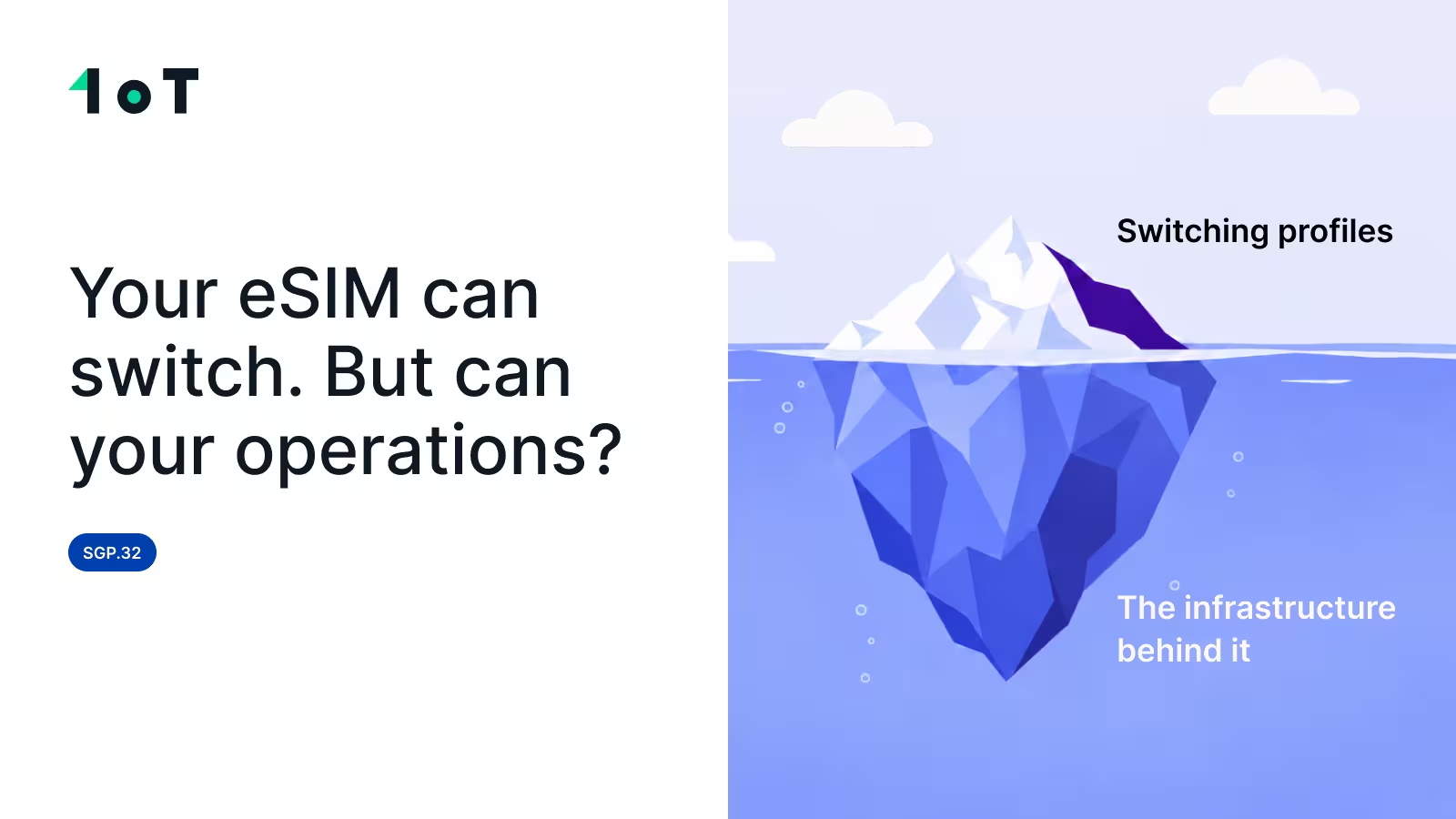
SGP.32 allows you to switch an operator profile remotely. It does not automatically preserve your APIs, alerts, reports, billing, permissions, or support workflows.
navigating-the-roaming-restrictions


