How Robot.com scales autonomous delivery on 1oT connectivity

Andrew Worth
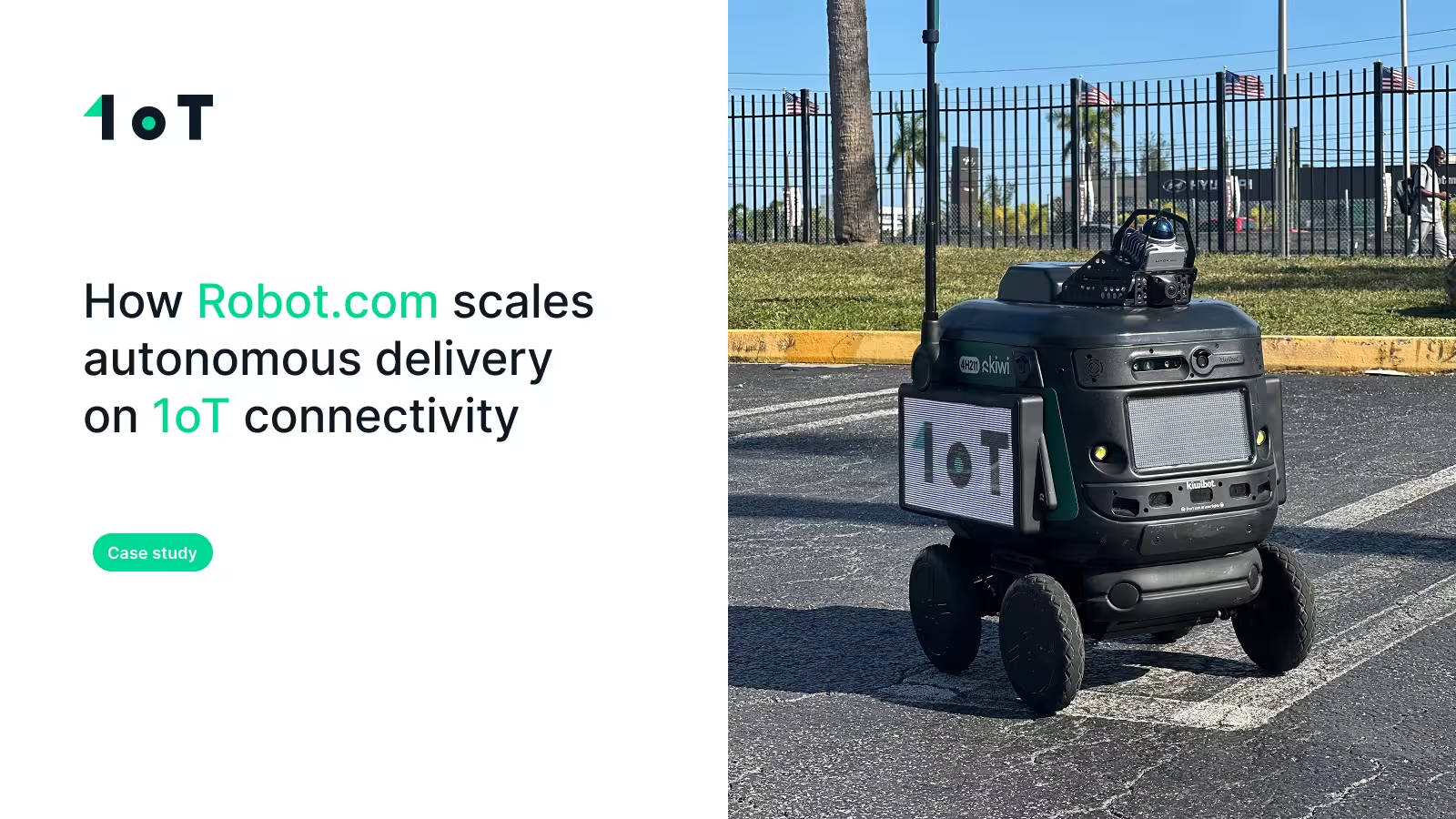
Robot.com (formerly Kiwibot) is a San Francisco-based robotics company that builds and operates autonomous delivery robots for real-world environments. Their robots handle last-mile delivery of meals, products, and packages, as well as mobile advertising campaigns - across university campuses, business districts, and urban environments in the US and beyond. Their R-Kiwi fleet operates at level 4 autonomy, meaning each robot handles all driving tasks within a defined area without human input. Each unit requires persistent cellular connectivity for telemetry, remote diagnostics, and fleet management - making network reliability a core operational requirement.
As their fleet expanded across the United States, the limits of their existing connectivity setup became clear. In 2024, Robot.com approached 1oT with a specific challenge: they needed a solution to keep over 400 r-kiwi units connected across diverse US geographies in a scalable, manageable way - and ensure connectivity remained stable regardless of the environment.
The Challenge: Connectivity in a high-stakes environment
For an autonomous delivery robot, a lost connection isn't just a minor delay - it's a complete halt in service. Before working with 1oT, Robot.com's fleet connectivity was managed through individual carrier SIMs provisioned per geography, with Pepwave routers handling the cellular link on each robot. Relying on a single network provider meant navigating dead zones and coverage gaps across diverse US geographies. Each new market required separate SIM procurement, manual provisioning, and independent monitoring.
As the fleet grew, so did the operational overhead: no centralized view of SIM status across the fleet, manual troubleshooting when a router failed to detect a SIM or lost connectivity, and time-consuming carrier negotiations each time they entered a new region. On top of that, they needed a solution that could handle high-density data requirements and maintain stable connectivity during high-impact events where cellular towers are pushed to their limits.
The Solution: Multi-network resilience
1oT provided Robot.com with a multi-network, scalable connectivity solution specifically tailored for their US expansion. By utilizing 1oT's eSIM technology, each robot gained access to Verizon, AT&T, and T-Mobile's networks, ensuring the best available connection regardless of location. 1oT's data breakouts, located on the West Coast, East Coast, and Midwest, reduce latency and provide redundancy - if one network's signal weakens, the robot automatically switches to the strongest available provider.
Alongside the connectivity layer, 1oT Terminal - 1oT's proprietary connectivity management platform - consolidated Robot.com's entire SIM lifecycle management into a single interface with multi-carrier, multi-region coverage. Their operations team gained real-time visibility across all connected units, simplifying provisioning and replacing the fragmented multi-carrier dashboard setup they had before. As Robot.com scaled from an initial test phase to over 200 active street-operating units within a year, managing their growing fleet became a single-platform operation.
Proven in the field
The true test of this infrastructure came during the Big Game 2025 - the annual NFL championship game and the single most watched sporting event in the US. The game drew over 65,000 fans to the Caesars Superdome in New Orleans, creating one of the most extreme stress tests for cellular networks imaginable. Robot.com deployed 50 branded robots near the venue, and while local cellular networks were pushed to their limits, every robot stayed online and operational. 1oT’s solid infrastructure proved that it could maintain high-performance connectivity even under extreme network congestion.
Beyond high-profile events, university campus operations across the US represent Robot.com's highest-density, highest-frequency use case for sustained cellular connectivity - R-Kiwi robots running autonomous delivery and advertising campaigns across multiple campuses, all relying on 1oT-managed SIMs. The same applies in Miami's Brickell district, where advertising-equipped robots operate continuously in a dense business environment.

Scaling beyond the U.S.
Robot.com has expanded into the EU, Canada, and the Middle East. Traditionally, entering a new country would mean negotiating with local telecoms and managing separate contracts. 1oT's multi-region coverage has been a practical enabler for these deployments - allowing Robot.com to activate connectivity in new markets without negotiating separate carrier agreements in each geography. Early-stage operations in Dubai and across the MENA region are already live, with 1oT's multi-carrier coverage simplifying connectivity setup in each new market.
The result
By partnering with 1oT, Robot.com has combined multi-carrier SIM management into one platform - now running connectivity for 200+ active street-operating units across the US and international markets from a single interface.
With 1oT's multi-network infrastructure proven under some of the most demanding network conditions in the world, and the ability to activate in new markets without separate carrier negotiations, Robot.com has the connectivity foundation in place to support wherever their fleet grows next.